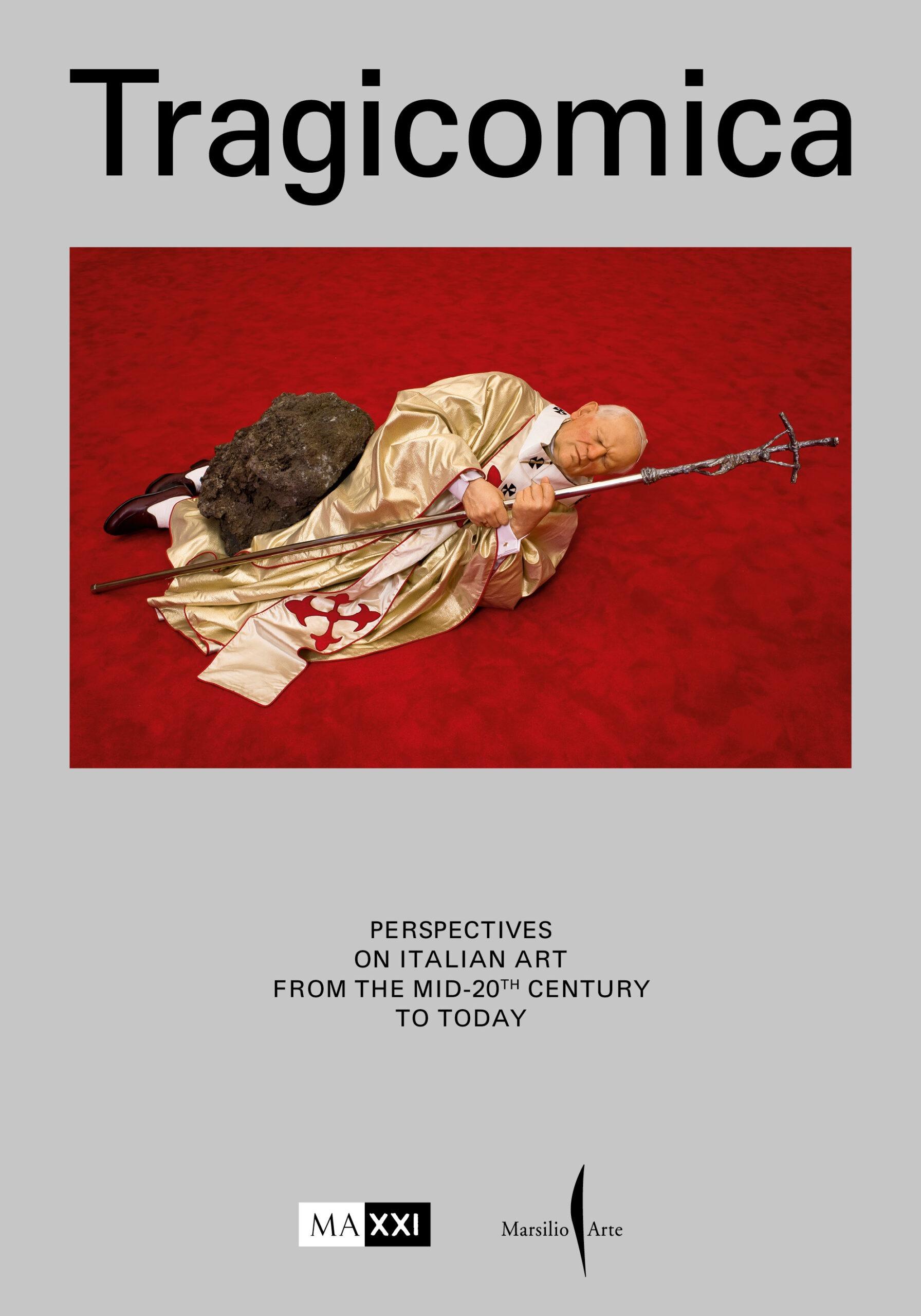
Tragicomica. Perspectives on Italian Art from Mid-20th Century to Today
edited by Andrea Bellini, Francesco Stocchi, with essays by Timothy Campbell, Giovanna Zapperi, Davide Oberto,
568
pages
,
1^
ed.
2026
-
Catalogues
-
ITA,ENG
-
ISBN 9791254633601
Published on the occasion of the exhibition Tragicomica: Perspectives on Italian Art from Mid-20th Century to Today (Rome, MAXXI, April 2nd – September 20th , 2026), this volume offers a new interpretative framework for understanding Italian art from the second half of the twentieth century to the present.
Whether expressed through farce, satire, self-reflexive comedy, irreverent provocation, or subtle irony, twentieth- and twenty-first-century Italian art is deeply infused with an anti-tragic impulse. Italian artists have articulated not only a sophisticated conception of the comic — as a mocking response to tragedy — but also as a means of confronting and transcending the drama of human existence. Positioning the tragicomic as both an interpretative lens and a defining feature of Italian culture, curators Andrea Bellini and Francesco Stocchi trace its development from the postwar period to today. A historical framework is combined with a multidisciplinary approach, encompassing art, cinema, theatre, architecture, design, literature, and philosophy, through contributions by the curators alongside leading scholars, critics, and cultural thinkers.
As Stocchi notes, «irony does not provide solutions; rather, it opens a space of ambiguity in which viewers are called upon to confront their own position within the system being represented». By complicating the process of interpretation, the tragicomic demands both intellectual engagement and self-reflection: as viewers grasp the critical intent underlying a work — and respond with a smile — they are prompted to reconsider their own position in relation to its subject.
Tragicomica foregrounds the specificity of this theme in the history of art from the postwar period to the present, with particular attention to feminist practices, which deploy irony, the grotesque, and the absurd as strategic tools to challenge gender inequality. The volume thus seeks to question the rigid, one-sided framework of patriarchal institutions, in which the masculine is positioned as the neutral author of history. Significant attention is devoted to women artists who have made the tragicomic central to their practice, enacting forms of symbolic resistance.
Within this context, humor emerges as a critical and political strategy — one capable of confronting power structures and unsettling established narratives through laughter. As Bellini emphasizes, «[…] the aim of reflecting on the comic is not to condemn laughter per se, but to distinguish between forms of comedy that open up emancipatory possibilities and those that instead reinforce hierarchies, humiliate vulnerable subjects, and — whether consciously or not — serve as rhetorical instruments of contemporary authoritarian tendencies». It is therefore crucial to distinguish between an institutionalized, overused form of comedy — often employed to obscure the symbolic violence embedded in political and cultural narratives — and a vital, subversive, and reflective humor that enables liberating laughter and fosters critical awareness.
An integral part of the exhibition, the catalogue features 19 essays offering a wide-ranging and nuanced critical overview of the subject. Contributors include Giovanna Zapperi, who opens the section on visual art; Timothy Campbell, who examines “feminine realism”; and Davide Oberto, who explores the tradition of Italian tragicomedy. The volume also includes images, a complete checklist of exhibited works, and an extensive bibliography.

book
47,00 €
47,00 €

Scegli dove comprare: