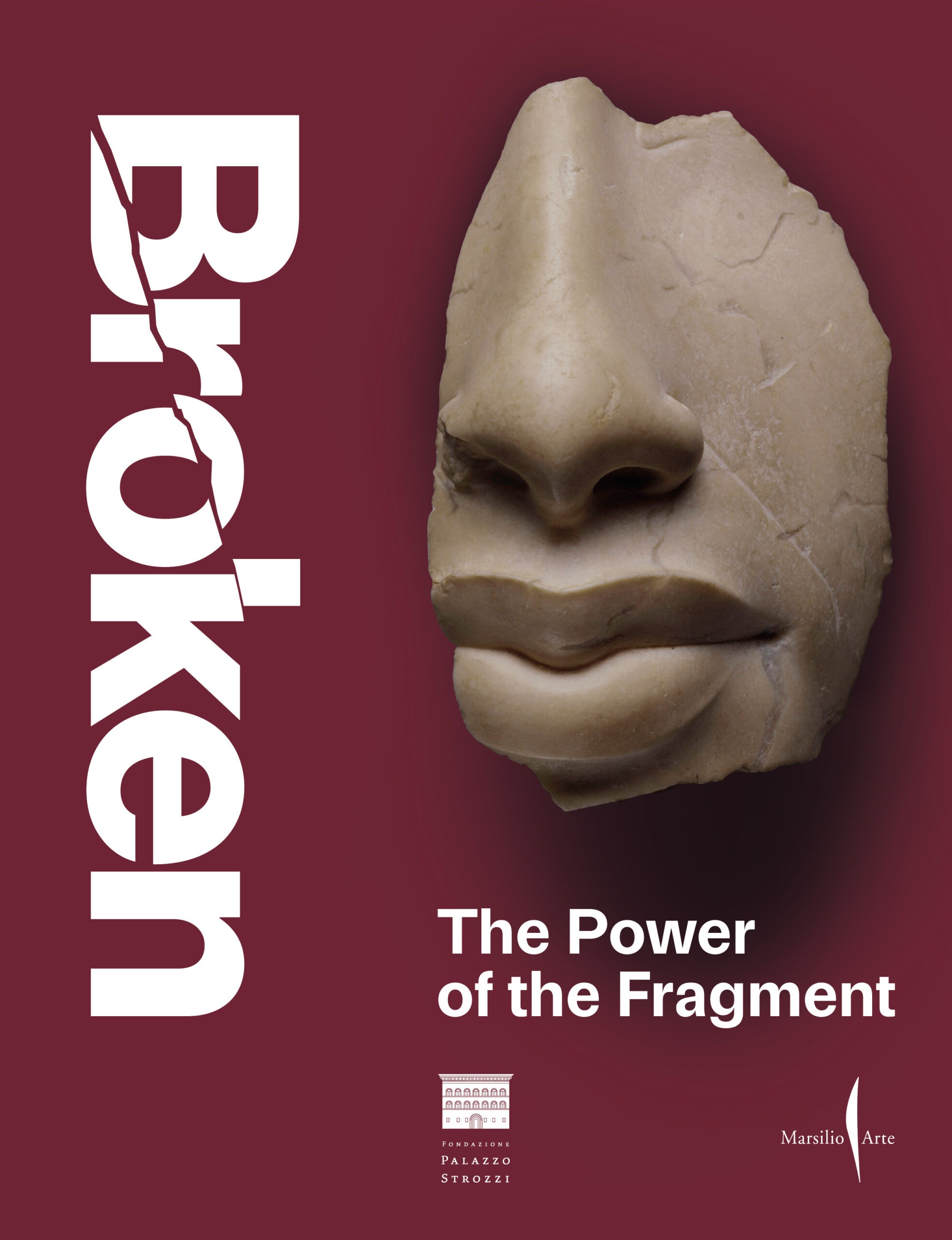
Broken
The Power of the Fragment
edited by Andrew Sears, Claude Douglas Dickerson ,
288
pages
,
1^
ed.
2026
-
Catalogues
-
IT,ENG
-
ISBN 9791254633793
On the occasion of the exhibition Broken. The Power of the Fragment, curated by C. D. Dickerson III and Andrew Sears, on view at Palazzo Strozzi in Florence from September 25 to January 24, 2027, Marsilio Arte publishes the exhibition’s namesake catalogue.
The exhibition, born from a joint project between the Fondazione Palazzo Strozzi and the National Gallery of Art in Washington, where it will open in spring 2027 in a specially calibrated installation, places at the center of its inquiry the aesthetic significance and symbolic scope of the fragment, showing how incompleteness, damage, or censorship do not diminish the expressive power of a work, but rather amplify its communicative “power.”
From the plastic expressions of antiquity to the contemporary era, Broken explores how the life of sculptural artifacts is constantly marked by vicissitudes and traumas of various kinds: natural disasters, the devastation of war, iconoclastic fury, devotional practices, or processes of reuse and material recontextualization. Ranging from artifacts dating back to the third millennium BC to the most recent artistic interventions, the exhibition examines the residual condition as an autonomous form of knowledge, reflecting on the dialectic between loss and memory to show how the wound left by time – or by the hand of man – can transform into a valuable stimulus for reading the present.
The publication accompanies the exhibition itinerary of broad international scope, bringing together more than eighty works thanks to an exceptional network of loans from the most important museums and private collections. The choral dimension of the exhibition is conveyed by the breadth of its transgeographic and transtemporal references: from the sculptural testimonies of Egypt and Etruria to the precolonial ones of Mali, Peru, and Cambodia, up to the masterpieces of old masters such as Giovanni Pisano, Michelangelo, and Auguste Rodin, which are set alongside the practices of artists such as Louise Bourgeois, Francesco Vezzoli, and Danh Vo. The itinerary concludes with the intervention of Mark Manders, who has created for the occasion a site-specific installation in the Renaissance Courtyard of Palazzo Strozzi.
The rich critical apparatus, with an introduction by directors Kaywin Feldman and Arturo Galansino, gathers the contributions of curators Dickerson and Sears alongside the multidisciplinary insights of A.E. Stallings, David Freedberg, Rosemarie Garland-Thomson, Miriam K. Said, George Wheeler, Stanley Abe, Timothy Morton, Joanna Fiduccia, and Cannupa Hanska Luger.
book
45 €
45 €

Scegli dove comprare: