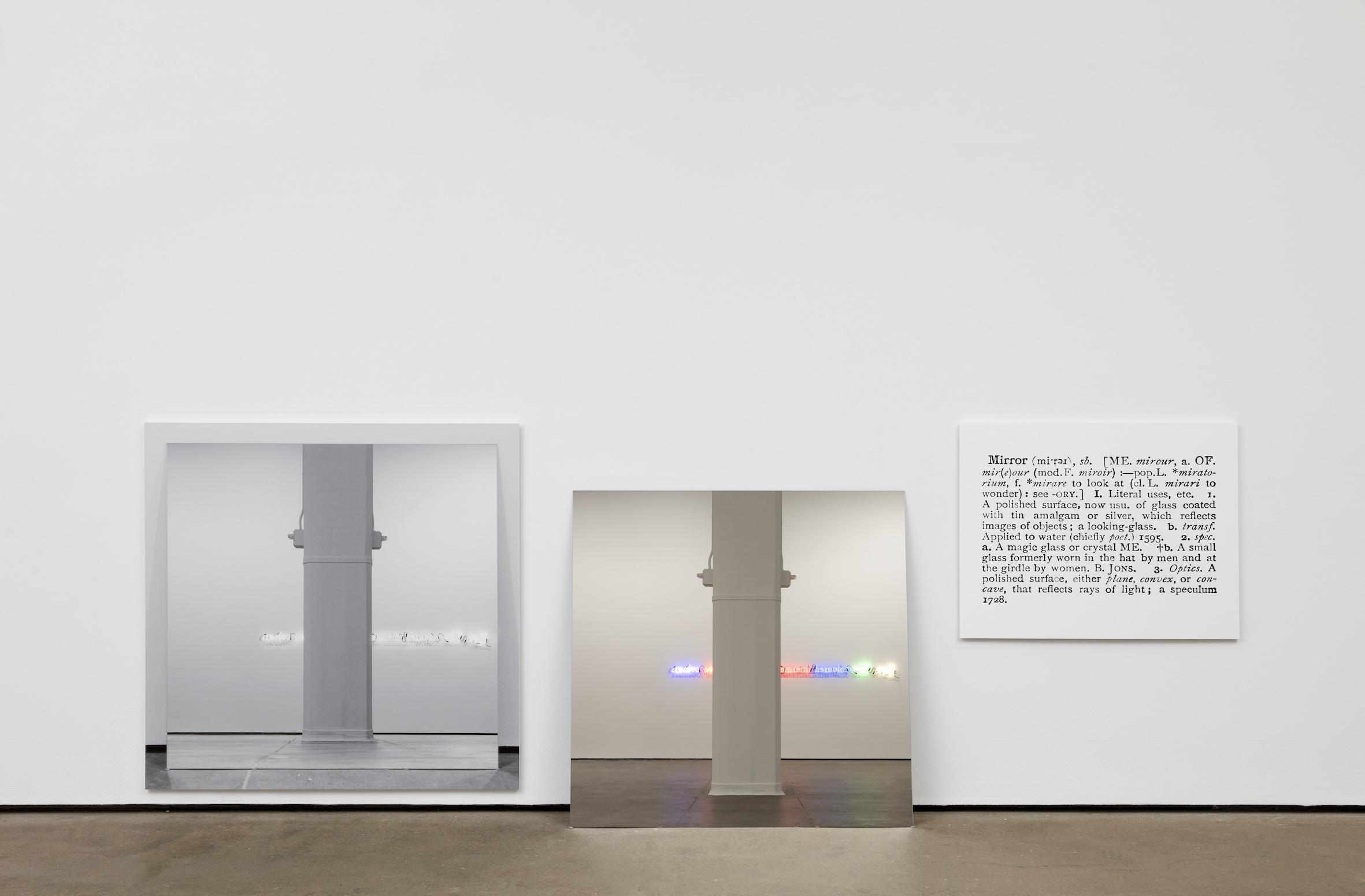
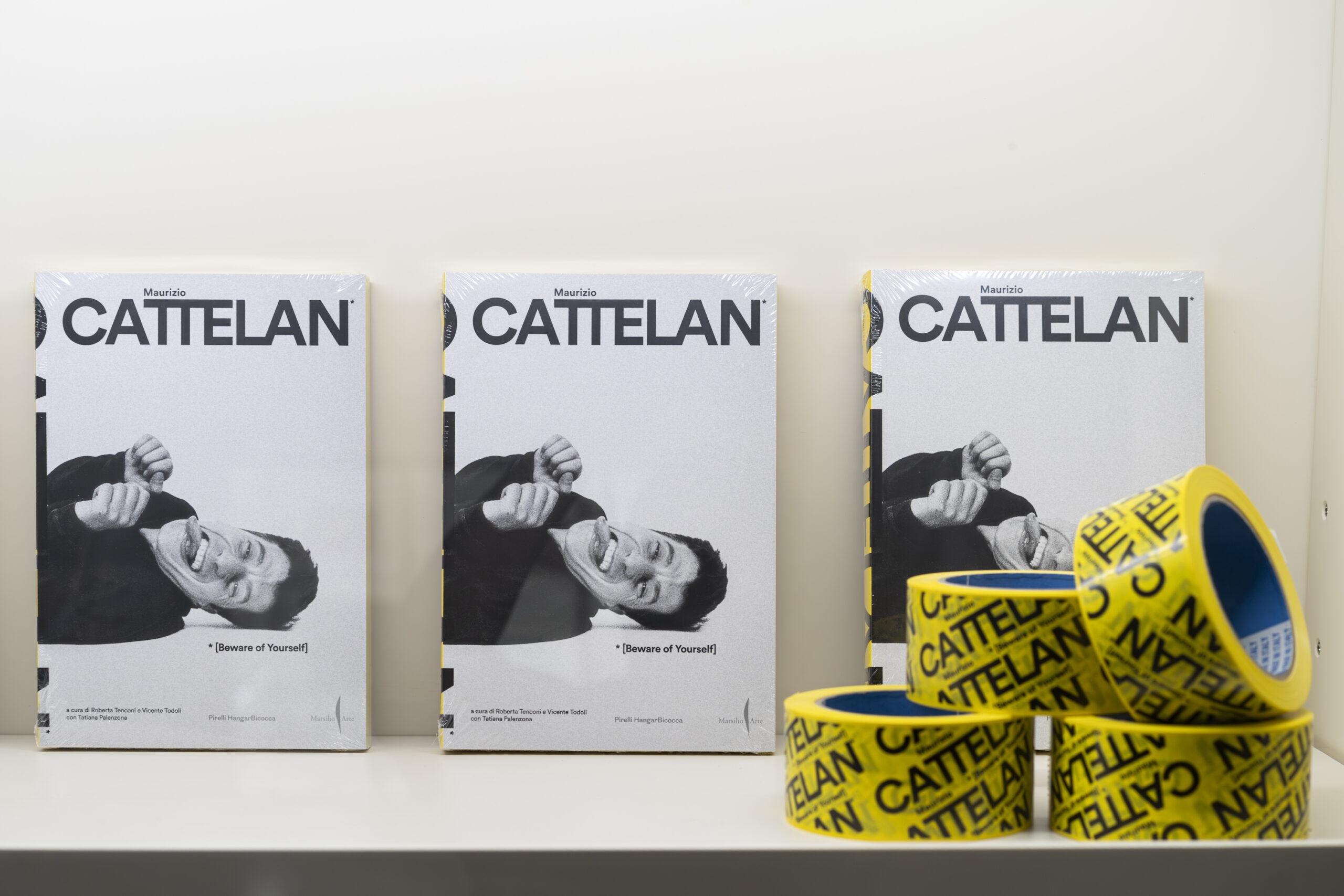
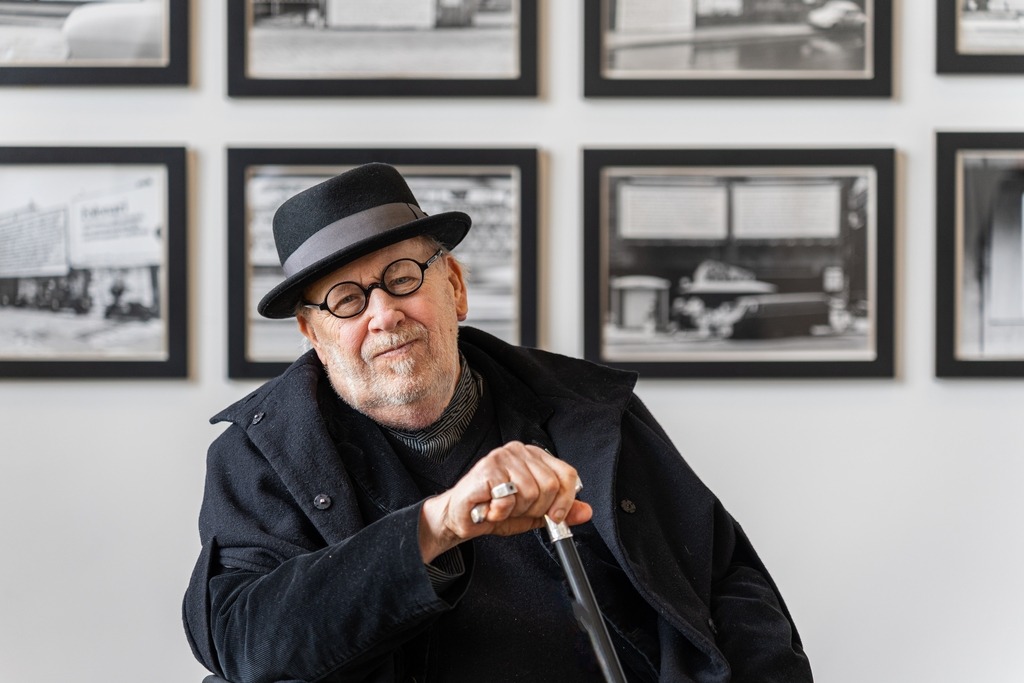
Joseph Kosuth, protagonist of the exhibition at the Casa dei Tre Oci in Venice – conceived and organised by Berggruen Arts & Culture and the Berggruen Institute Europe, and curated by Mario Codognato and Adriana Rispoli – answers questions from his colleague Maurizio Cattelan. The result is a dialogue that ranges from philosophy to art, with a touch of irony
Maurizio Cattelan: Joseph, you’ve filled the entrance hall of Casa dei Tre Oci with a text by Michel Foucault discussing ‘resemblances’ and ‘conveniences.’ But if, as your exhibition title (The-Exchange-Value-of-Language-Has-Fallen-To-Zero) suggests, the exchange value of language has dropped to zero, wouldn’t it have been more consistent to leave the walls completely blank?
Joseph Kosuth: I was tempted to respond ‘How can you be sure that I haven’t?’. With then, the suggestion being that my text has a meta-esque relationship with the site of the whole exhibition. The point being that the relevant questions in art, remain ontological.
Cattelan: You’ve lived in Venice for many years and witnessed dozens of Biennales. In your opinion, is Conceptual art the only thing that hasn’t yet drowned in the lagoon, or has it become an antique-as reassuring as 18th-century furniture?
Kosuth: Not just ‘witnessed’ but participated in many Biennales, which is a significantly different view. In other words I’m no passive victim. It’s been my experience that when it was any good the conceptual art actually removed the furniture from the room.
Cattelan: The work ‘A Chain of Resemblance’ transforms philosophy into a luminous object. Do you think visitors actually stop to reflect on epistemology, or has neon simply become the perfect lighting for a well-angled selfie?
Kosuth: The beauty of what the visitors bring to any work of art is their own special level of ignorance toward what they are viewing. Your question elegantly covers the range of possibilities.
Cattelan: You’ve dedicated works to Piet Mondrian, Immanuel Kant, Franz Kafka, and now Foucault. Do you feel more like an artist creating worlds, or a translator shedding new light on the genius of those who are no longer with us?
Kosuth: How can you say they aren’t with us? The discourse your question refers to contradicts you. The implication of your question is risky, so let’s not denigrate all the work of the dead just because we happen to be alive. Apparently.
Cattelan: For Ca’ Foscari University, you worked on Carlo Scarpa. He used concrete and water; you use dictionary definitions. In the end, which of you has left a more ‘concrete’ mark?
Kosuth: I used dictionary definitions between 1966 and 1968. We need to go back nearly sixty years to find relevant examples? Thanks for the compliment, but you are too kind! But, to respond in another way, what I’ve contributed has been useful, and we’ve seen in what ways, but what Carlo contributed is actually useful in a practical way.
Cattelan: You’ve always maintained that art is an idea: “Art as Idea as Idea.” But today, with ideas flying through the cloud at high speed, is the weight of an intuition still measured by intellectual intensity, or is it now measured by market value?
Kosuth: Well, those are the horns of our dilemma, no? The enterprise of making art is making meaning, and we find ourselves as artists in a struggle with the market over who/what will provide that meaning. Probably ‒ and I say this optimistically ‒ it’s only our ‘intellectual intensity’ that will provide sufficient authenticity to resist the collapse of artistic meaning into what the market offers.
Cattelan: You’ve used neon for decades. When a letter burns out in one of your installations, does the work acquire a new meaning, or do you view it simply as an unexpected silence in the conversation?
Kosuth: It mutely retains its old meaning as it waits for a repair.
Cattelan: Joseph, have you ever had the forbidden urge to paint a sunset ‒ or perhaps a dog ‒without feeling the need to explain why you were doing it?
Kosuth: This is not the kind of ‘forbidden urge’ that worries me.
Cattelan: If you could erase a single word from every dictionary in the world just to see the effect it had on reality, which one would you choose?
Kosuth: The word ‘Dictionary’ on the cover.
Cattelan: Is it more rewarding to be understood deeply by ten philosophers or to be loved by a thousand people who don’t even know who Wittgenstein was?
Kosuth: My goal has always been to be understood by a thousand philosophers who would each then explain convincingly and deeply to ten people each, why Wittgenstein matters.
Cattelan: Has Conceptual art truly won its battle, or has it become the “elegant font” of a system that has run out of things to say?
Kosuth: Conceptual art, as I see it, is a methodological reconsideration of the practice of art, and thus its meaning, freeing it from an a priori definition. So it sees art as a verb, not a noun.
Cattelan: What is the next exhibition you’re going to see?
Kosuth: This one I really can’t answer.
Cattelan: One last question ‒ the hardest one. If you were a philosophical text, which one would you be?
Kosuth: The menu on the last spaceship leaving earth.
Interview made in collaboration with la Lettura of Corriere della Sera
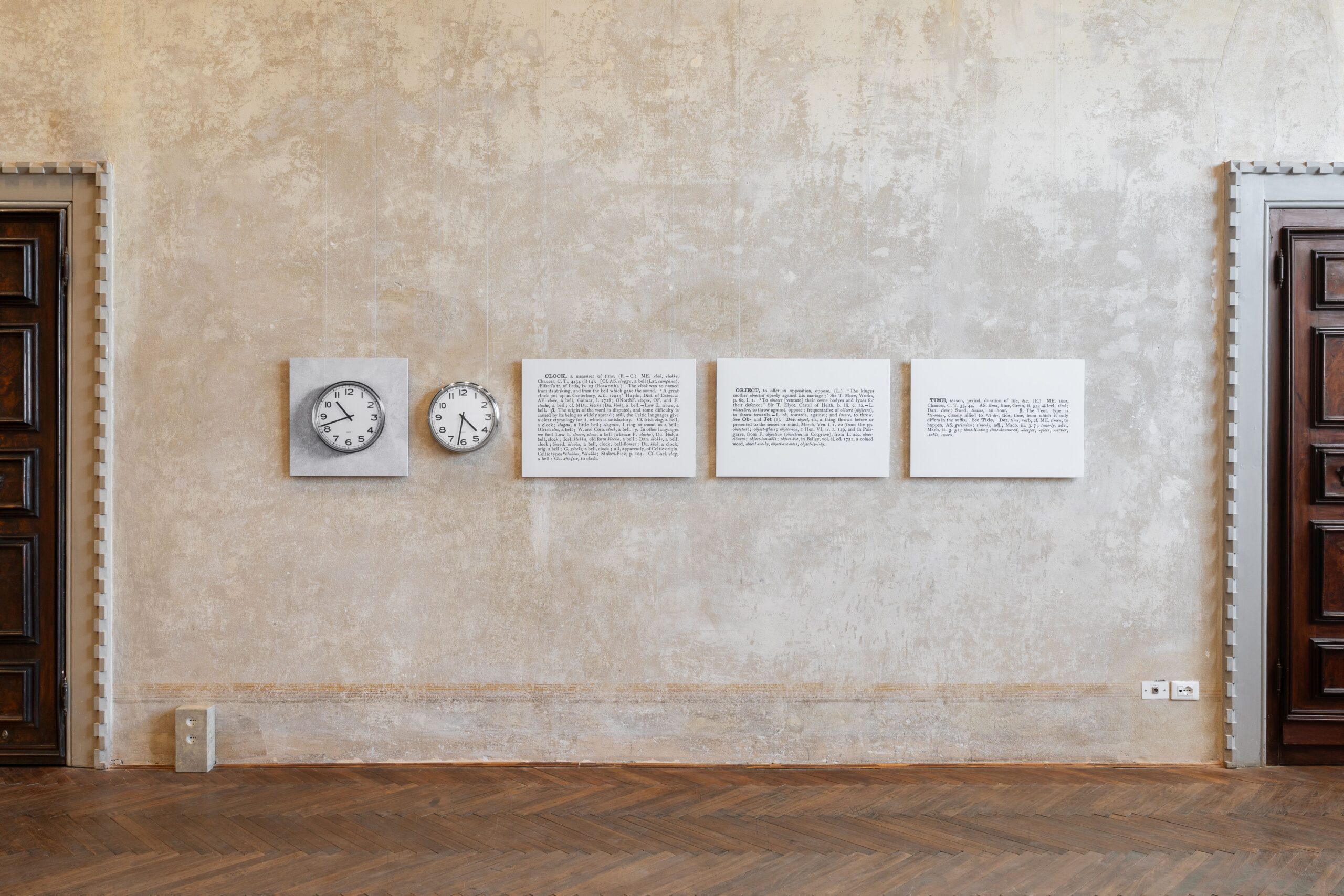
The-Exchange-Value-of-Language-Has-Fallen-To-Zero, installation view, Clock (One and Five), courtesy Galleria Lia Rumma. Casa dei Tre Oci, Venice 2026. Photo Marco Cappelletti
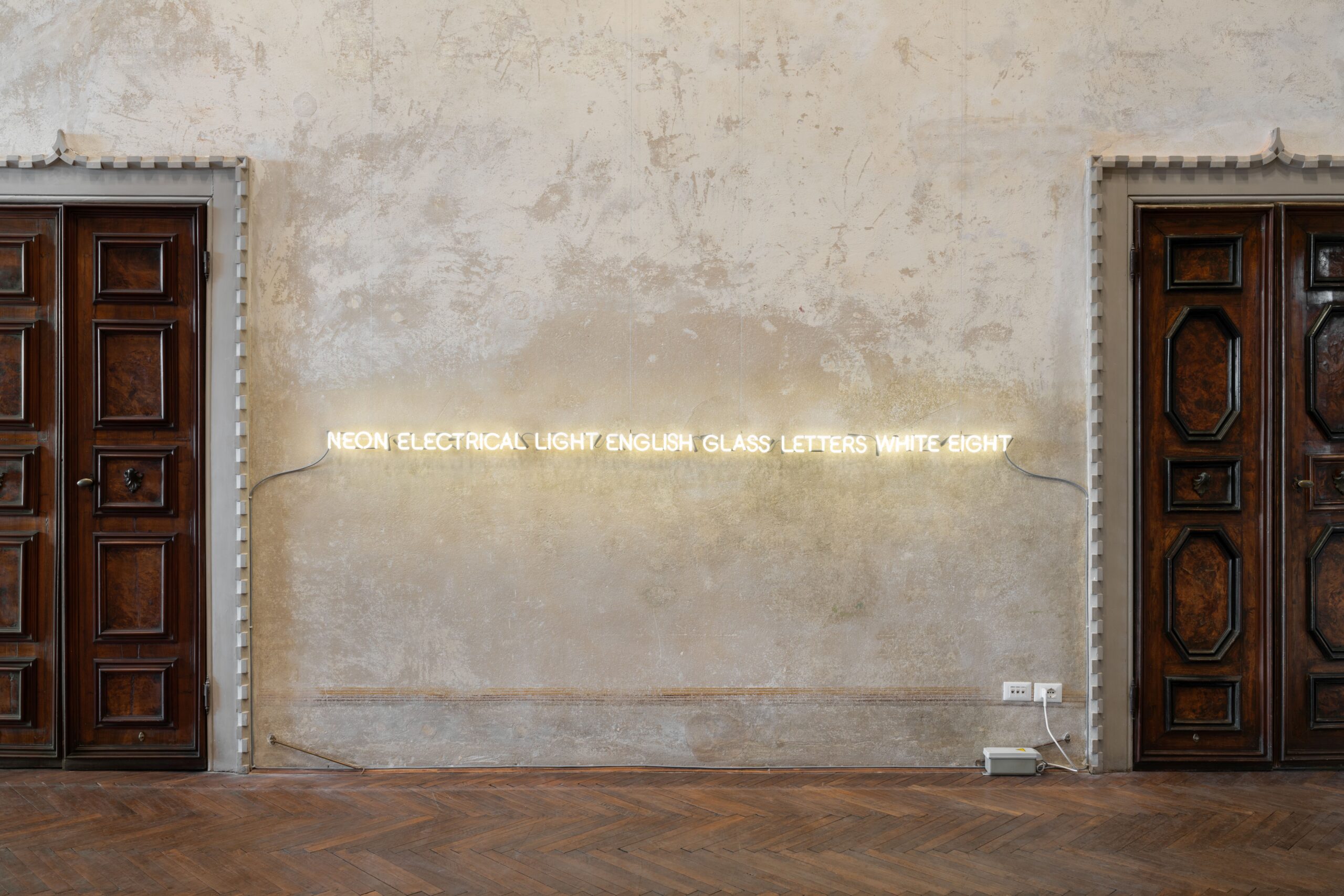
The-Exchange-Value-of-Language-Has-Fallen-To-Zero, installation view, One and Eight – A Description. Casa dei Tre Oci, Venice 2026. Photo Marco Cappelletti
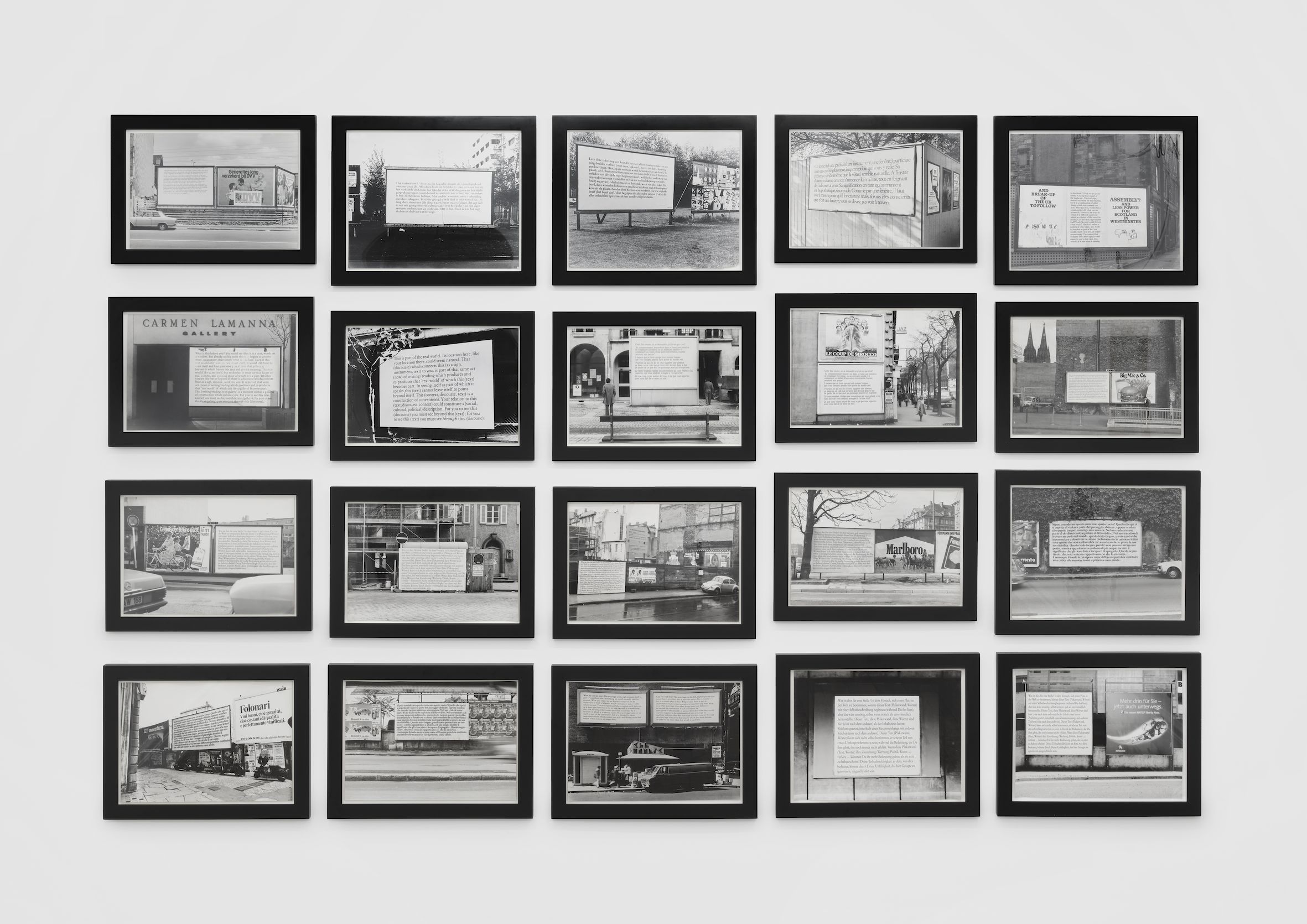
Joseph Kosuth, Text/Context, 1978-1979. Courtesy the artist and Sprüth Magers. Photo by Ben Westoby
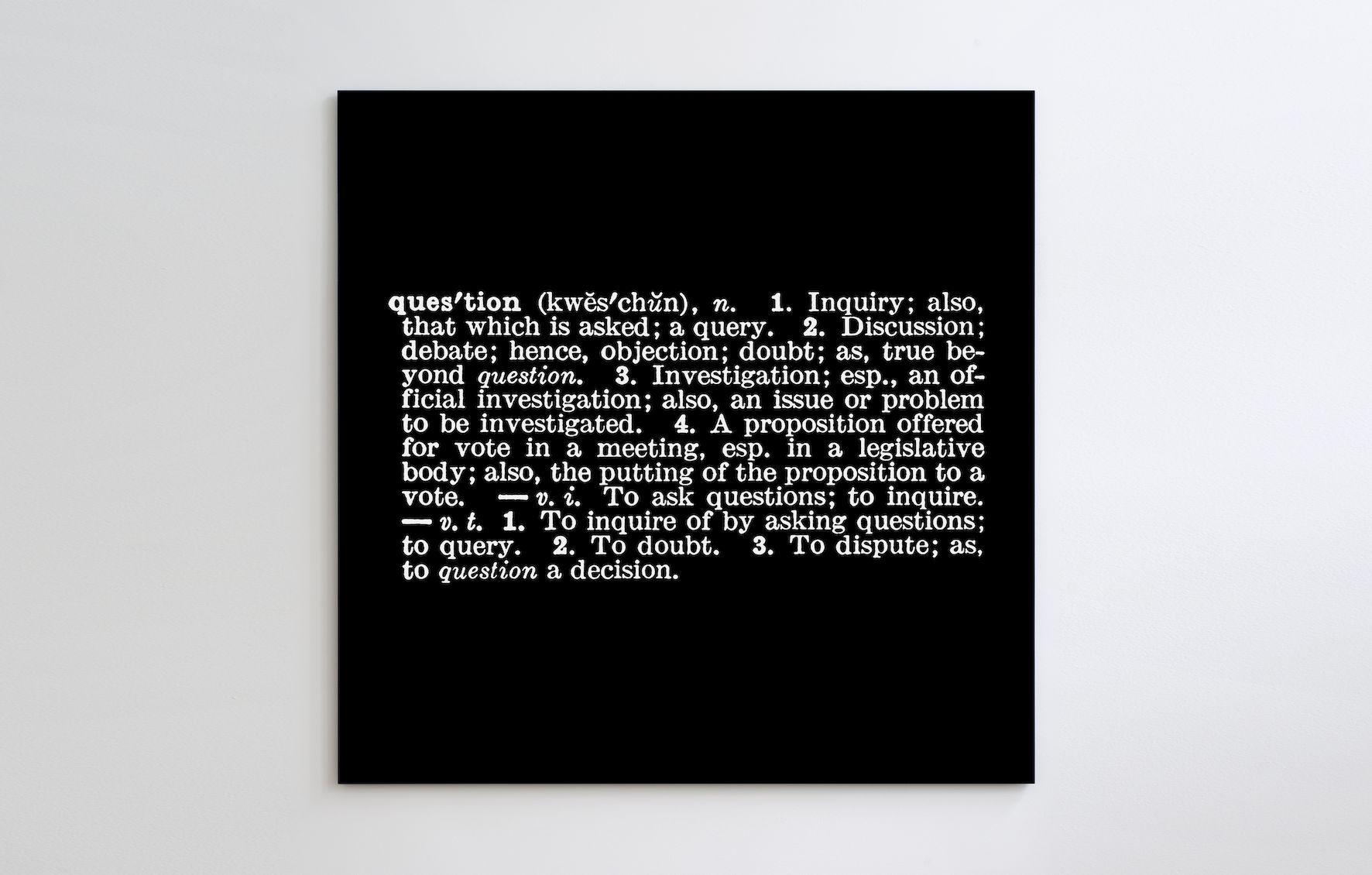
Joseph Kosuth, Titled (Art As Idea As Idea) [question] (Eng. Webster N.D.), 1967. Mounted photograph, 122 x 122 cm. Private collection, Courtesy the artist and Almine Rech Gallery. Photo (rendering) Joseph Kosuth Studio
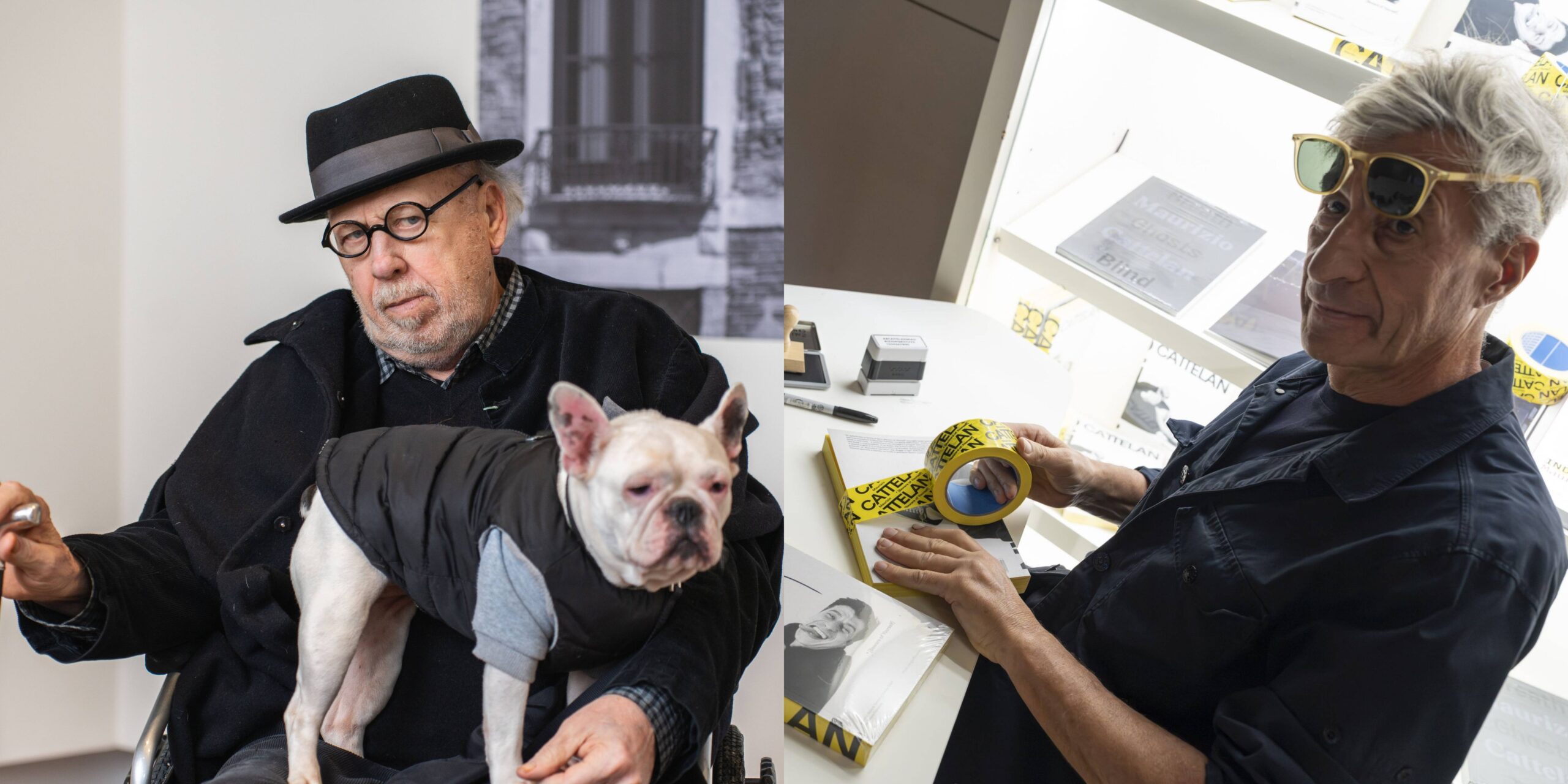
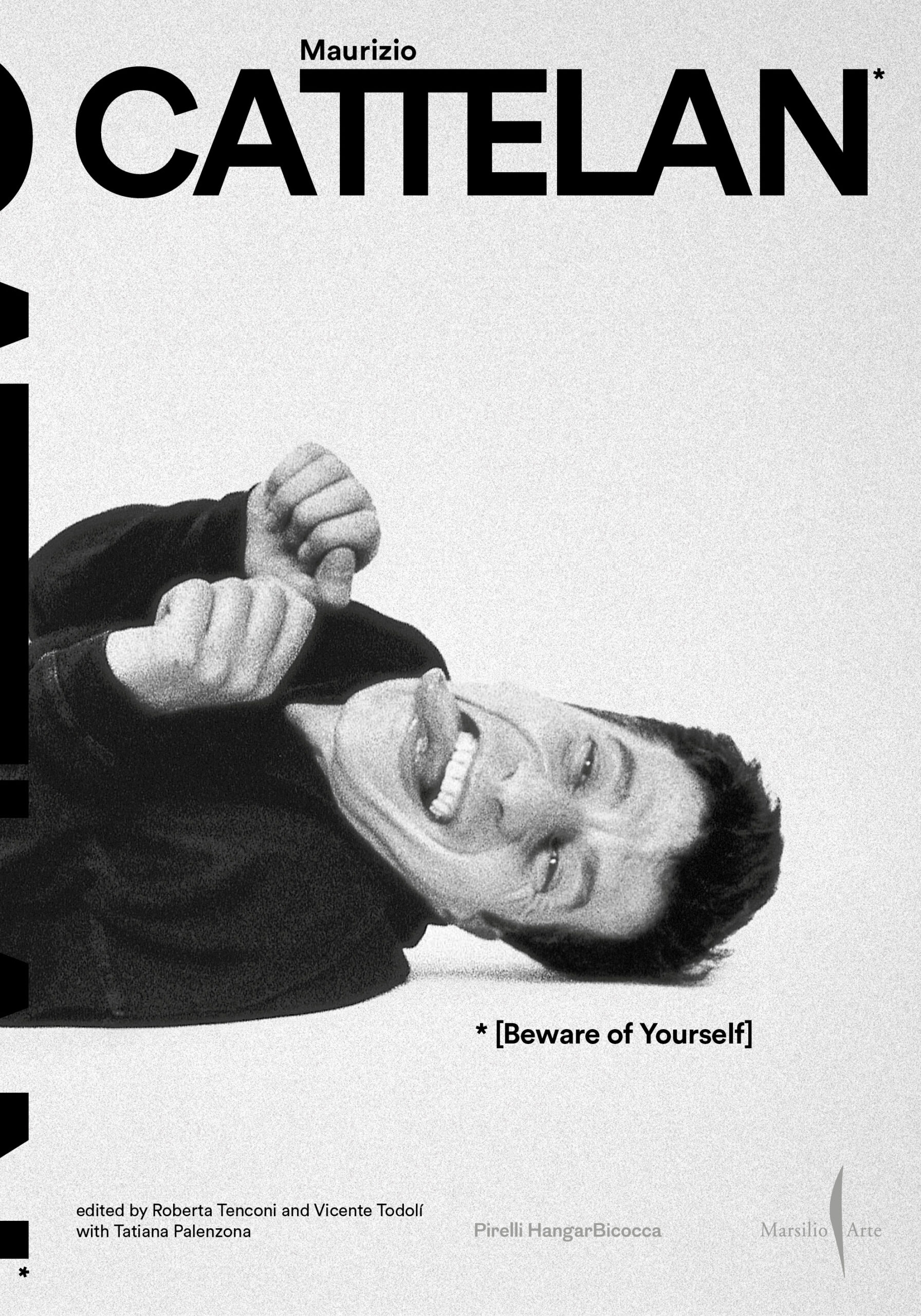
From left to right: Joseph Kosuth. Photo Matteo Catania – Hubove Studio. Maurizio Cattelan. Photo Lorenzo Palmieri (cover photo)


Related products
Related Articles