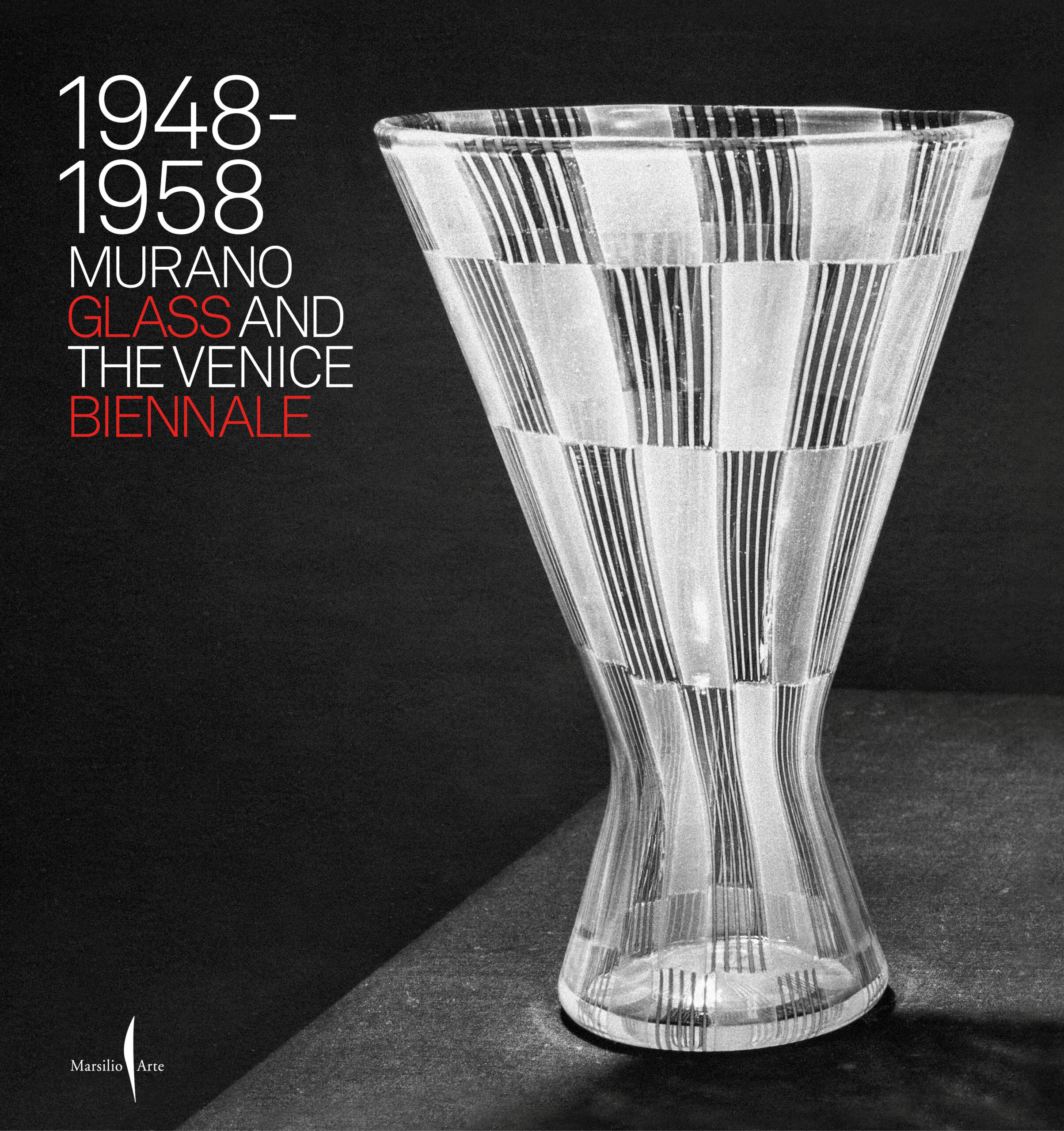
1948-1958. Murano Glass and the Venice Biennale
480
pages
,
1^
ed.
2026
-
Catalogues
-
ENG
-
ISBN 9791254633496
An account through critical essays, documents, and images of Murano glass at the Venice Biennale during the economic boom years
The catalogue, edited by Marino Barovier, illustrates the works exhibited by Murano glassworks in the Venice Biennale editions from 1948 to 1958. Born from a joint initiative of the Fondazione Giorgio Cini and Pentagram Stiftung, with the participation of the Institute of Art History and the Glass Study Centre, the volume documents the exhibition held at Le Stanze del Vetro (Island of San Giorgio Maggiore) on the occasion of the 61st Venice Biennale, this contribute presents the evolution of Murano glassmaking during a decade of extraordinary significance for its history.
The beginning of this radiant period marks the resumption of the Biennale’s activities in the aftermath of the Second World War, testifying to the renewed vitality of Murano’s production through the works of historic glassworks, alongside newly established ones and artists exhibiting in a personal capacity. The decade from 1948 to 1958 represents an exceptionally fertile season for Murano, in harmony with the fervor animating various sectors of the applied arts, thanks to the economic boom and the rise of design culture. The Venice Pavilion at the Giardini della Biennale serves as a space dedicated to the decorative arts, where glassworks present their finest output to the public, created specifically for the occasion and selected by a committee of experts. Some of the most renowned glassworks showcase pieces of the highest quality, transcending, in the words of Renata Codello, Secretary General of the Fondazione Giorgio Cini, “the boundaries of craftsmanship to establish themselves as authentic artistic creations” in dialogue with contemporary design. During the 1950s, the Biennale became a “privileged observatory of the transformations underway”, and Venice “successfully established itself as an international laboratory” in the post-war context, in a decade that demanded the reconstruction not only of cities, but also of consciences.
The result of meticulous documentary and archival research and the cross-referencing of sources, the catalogue is divided into six chapters corresponding to the different editions of the Biennale featured in the volume. Each chapter includes an introductory note and a section dedicated to documentary material – organized by glassworks – along with a complete list of the exhibited works. Finally, a rich repertoire of photographic plates showcases the works selected for the exhibition, accompanied by technical descriptions and supplementary critical apparatus.
The essays provide an overview of this specific historical and artistic evolution of glassmaking. While Marino Barovier develops the theme of the dialogue between tradition and experimentation through the chronicle of a vibrantly creative decade, Carla Sonego focuses on the “exceptional nature” of the Murano glass exhibition at the 24th Biennale. Cristina Beltrami, on the other hand, dwells on the tactile component of glass, “which begins to be considered a sculptural material in its most contemporary and experimental forms”, while Massimo Martignoni investigates the “relationship between Murano glassmaking and design during the rise of mass society”, with reference to the historical context and the expectations for “a product devoid of practical purposes”.
book
70 €
70 €

Scegli dove comprare: